




Strategic Decision- Making for Lead (Cyprus)

Helping business maximise real-world impact

Strategic Decision-Making for Leaders

My organisation is funding my place

I am self-funding my place

Overview

Organisational leaders are often called to make strategic decisions in uncertain and complex situations. Making effective decisions requires the adoption of approaches that fit the complexities of these situations, and the efficient management of decision-making processes.
It also requires the ability to think strategically in highly interactive markets and with insights into the psychology behind people’s behaviour. Decisionmaking skills can be learned, and this programme blends theory and practice to help you become a more effective decision-maker.
Top five challenges
Leaders come to Cambridge to solve challenges in their organisations. If you are facing one of these five challenges, this programme will help you solve it.
01
How to improve the quality of your decisions
02
How to manage “unknown unknowns” and Black Swans
03
How to influence social dynamics in organisations
04
How to make strategic decisions in a competitive market environment using tools such as judo strategy
05
How to apply behavioural insights to influence people using tools such as nudge strategies

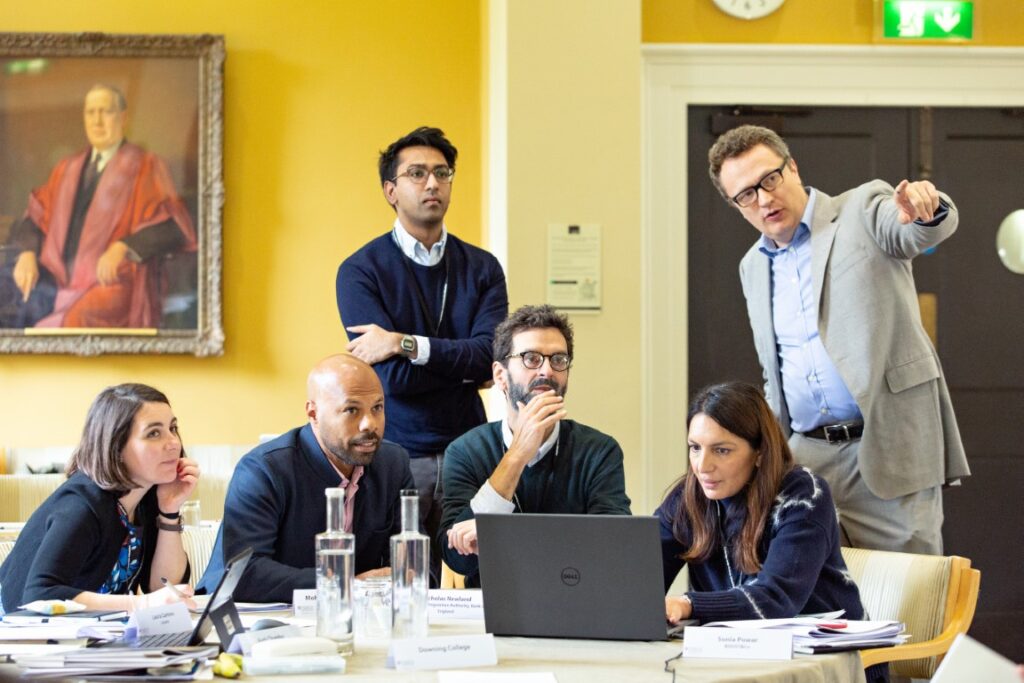
The Strategic Decision Making for Leaders programme addresses the decision making challenges that organisational leaders face at three levels: the individual level; the group and organisational level; and the market level. Your learning journey will involve examining decision making issues at all three levels and learning how to manage them with different frameworks and tools. We will draw upon lessons learned from multiple contexts, including the COVID-19 pandemic and the ever-rising concerns for environmental, social, and governance issues. Through simulations, exercises, cases, videos, and lectures, the programme will draw out learnings that you can apply when making decisions in your organisation, your team, and by yourself.

Duration & Venue

2 days (Face-to-face)

Fees

£3,300 + 19% Cyprus VAT

Dates

3-4 December 2026

Benefits & Programme Content

Programme key themes

  • At the individual level (when uncertainty overwhelms us).
  • At the group and organisational level (where we are “biased” by social interactions and implicit cultural assumptions).
  • At the market level of decision making (where you need to intuit and pre-empt the behaviour of competitors and customers) .

Who should attend

Frameworks & Tools

At the individual level of decision making:
  • A framework for thinking about
    the unknown.
  • Counterfactual reasoning and the
    Baconian method.
At the group and organisational level of decision making:
  • Social emotions as
    motivation drivers.
  • A framework of cultural
    filters.
At the market level of decision making:
  • Judo strategy.
  •  Nudge strategies.

Your learning journey

Module 1:
Individual level of decision making
This module helps you understand judgement and decision making under uncertainty, especially its behavioural aspects. In particular, it deals with understanding and managing ambiguity, “unknown unknowns”, and Black Swans.

By the end of this module, you will be able to:

  • Understand the main challenges individuals face
    when making decisions in situations of extreme
    uncertainty.
  • Strengthen your ability to manage and improve
    your own decision-making processes.
  • Identify the major sources of decision-making
    failures at the group level.
  • Enhance your capacity to lead group decisionmaking
    processes effectively.
Module 2:
Group and organisational level of decision making
This module helps you understand group dynamics, leadership, and emotions, and how your organisational culture shapes decisions.

By the end of this module, you will be able to:

  • Understand the social character of human
    intelligence.
  • Understand the essence of culture as social
    learning.
  • Learn how to guide culture.
  • Identify a small number of key social dynamics
    and influence them in ways that positively affect
    the way groups and organisations make decisions.
Module 3:
The market level of decision making
This module helps you understand the importance of strategic intelligence in a competitive marketplace. You will learn insights about competing strategically and pre-empting your competitors. You will also learn about influencing people using behavioural insights.

By the end of this module, you will be able to:

  • Understand and succeed in a competitive market
    environment using tools such as judo strategy.
  • Apply behavioural insights to influence people
    using tools such as nudge strategies.

Programme areas of focus

This programme examines strategic decision making
for organisational leaders at three levels:
At the individual level of decision making
  • Judgment and decision-making under uncertainty.
  • Understanding and managing “unknown unknowns” and Black Swans.
At the market level of decision making
  • Strategic decisions in a competitive market; application of judo strategy.
  • Applications of behavioural insights, in particular nudge strategies.
At the group and organisational level of decision making
  • How our decisions are influenced by social interactions (sometimes  in ways that point away from the strategic goals).
  • How culture provides wisdom, or “intuition,” in complex situations that we as individuals cannot fully analyse our way through, but this intuition may sometimes reduce our ability to take new paths.

Faculty & speakers

Learn from our world-class faculty who bring fresh insights from their leading-edge research into all of our Executive Education programmes.  The Academic Programme Director (APD) for the Transformational Leadership programme is Professor Andreas Richter. 

Access profiles of the programme’s APD and faculty:
Professor Vincent Mak

Professor of Marketing & Decision Sciences

Vincent’s research lies in how people and firms make strategic decisions as they interact with each other, and what economic and psychological factors influence those decisions. His research interests cover pricing, search decisions in networks and queues, decisions in competitive environments, competitive strategies, game theory, and experimental economics. His recent projects include, for example, how consumers search for marketing offers, how managerial committees make decisions, and how R&D managers can be incentivised to align their interests with their company’s. Vincent is on the Editorial Review Board of the journal Production & Operations Management. He was previously a case writer at the University of Hong Kong’s Centre for Asian Business Cases (now Asia Case Research Centre), producing over 20 business cases which have been used worldwide. His recent consulting work includes a study of online/offline retail prices and price comparison websites, as well as a consumer survey study on the functioning of the market for Internet access, both commissioned by the European Commission. He has also worked as a columnist, journalist, editor, and freelance writer/broadcaster in the Hong Kong media specialising in classical music and the arts. Vincent was a Visiting Assistant Professor at the Hong Kong University of Science and Technology prior to joining Cambridge Judge Business School.

Alberto Feduzi

Associate Professor of Economics

Alberto Feduzi is Associate Professor of Economics in the Department of Business Studies at Roma Tre University and a Research Fellow and former Professor of Management Practice at the Cambridge Judge Business School, University of Cambridge. He holds a PhD from the University of Cambridge, and his research focuses on judgment and decision-making under uncertainty. His work has been published in leading journals such as Academy of Management Review, Organizational Behavior and Human Decision Processes, Public Administration Review, and The British Journal for the Philosophy of Science. He currently serves as an Area Editor for the European Management Review.

Certificate of Attendance

Upon successful completion of the programme, you will be awarded a digital certificate of attendance by Cambridge Judge Business School Executive Education.

Video

Why Cambridge?

All of our programmes offer the same quality and academic rigour one associates with a Cambridge University education:
Faculty
Why Cambridge?
Why Cambridge?
Why Cambridge?

Speak to a
programme advisor

If you have any questions or would like to discuss how this programme could benefit you or your organisation, please get in touch with the programme co-ordinator.

Yangos Hadjiyannis

CEO, CIM-Cyprus Business School

Get in touch