Cambridge TL Program, 2026

Helping business maximise real-world impact

Leadership that stretches beyond the ordinary

Transformational Leadership (Cyprus)

My organisation is funding my place

I am self-funding my place

Overview

This two-day programme aims to provide you with inspiration, tools and knowledge to enhance your leadership skills. It will help you strike the right balance between inspirational leadership and result-oriented management.
This will enable you to develop a flexible leadership style to meet the diverse needs of your people. You will gain insight into motivating your people beyond simple monetary incentives, creating stimulating work and engaging working relationships. Covering more difficult topics, it will offer ways to overcome resistance to change and use influence to support your objectives.
Top five challenges
Leaders come to Cambridge to solve challenges in their organisations. If you are facing one of these five challenges, this programme will help you solve it.
01

How to adapt your leadership style to the diverse needs of your employees

02

How to handle ‘difficult’ colleagues in
your organisation

03

How to get buy-in from your peers to
new ideas they may find daunting

04

How to motivate employees without
using formal authority

05

How to manage change effectively in
your organis

Leadership today is often in the context of change and being able to carry people with you is a vital skill separating leaders from managers. The ability to motivate without resorting to formal authority and persuasion rather than instruction have never been more important. Equally the ability to tailor your leadership style according to the needs of individuals is a skill with a high premium today. Using frameworks and tools, together with the peer interaction within the programme, we will equip you to take that step into true leadership.”“

Duration & Venue

2 days (Face-to-face)

Fees

£3,300 + 19% Cyprus VAT

Dates

3-4 December 2026

Benefits and Programme content

Programme key themes

Who should attend

Featured case studies

Lorem ipsum dolor sit amet, consectetur adipiscing elit. Ut elit tellus, luctus nec ullamcorper mattis, pulvinar dapibus leo.

Leadership today is often in the context of change and being able to carry people with you is a vital skill separating leaders from managers. The ability to motivate without resorting to formal authority and persuasion rather than instruction have never been more important. Equally the ability to tailor your leadership style according to the needs of individuals is a skill with a high premium today. Using frameworks and tools, together with the peer interaction within the programme, we will equip you to take that step into true leadership.”“

Your learning journey

Module 1:
Leadership styles
This module examines different organisational leadership styles, including situational and transformational. You will explore your own leadership styles and discuss whether you can adapt them to the often diverse needs of your employees. You will explore the different skills associated these different leadership styles, and will discuss how leadership can inspire employees, whilst at the same time achieve results.

By the end of this module, you will understand:

  • The different types of leadership styles.
  • Your dominant leadership approach.
  •  How to adapt your leadership style to meet the
    needs of your employees.
Module 2:
Managing change
This module explores how you can effectively introduce and manage change in your organisation and will provide you with some key steps for doing so. The session covers themes such as whether a ‘top down’ or ‘bottom up’ approach works best, whether the adoption of change should be incremental, and the effects of social and informal networks on organisational change. You will “practice” change management by working in teams on a real-life change management simulation. We will explore how to initiate and carry through a change management project, in order to create buy-in and breach resistance to change. We will also zoom in on our own change management initiatives and exchange experiences, tips, and tools.

By the end of this module, you will understand:

  • Different approaches to leading organisational
    change.
  •  How to manage resistance to change.
  • How social and informal networks can help
    facilitate change.
Module 3:
Persuasion & influence
This module is concerned with the common situation where delegates have the right arguments and data in favour of their proposal, but for some reason are not as persuasive as they think they should be, or need to be. The module draws on both the art and the science of effective persuasion in F2F and social situations. It addresses strategies and tactics of social influence and how to persuade and influence colleagues to get results.

By the end of this module, you will understand:

  • The ‘art’ and ‘science’ of effective persuasio.
  • The role of social dynamics that influence
    persuasion efforts.
  •  A ‘process view’ of persuasion that is sensitive to
    time – the question of ‘when’ persuasion tactics
    are more or less effective.
Module 4:
Motivating employees
Many managers face the tough issue of how to motivate employees in jobs that are not very inspiring and where monetary incentives are not available or insufficient. In this class, we will apply motivation concepts and tools to managerial practice. We will combine a simulation analysis with a few self-awareness tools and an exploration of the problems that participants face in managing their teams.

By the end of this module, you will understand:

  • Understand some of the key motivators of human behaviour.
  • Acquire novel ideas on how to motivate employees beyond money.
  • Understand the importance of designing motivating work, as well as how to redesign work so that it is more motivating.

Faculty & speakers

Learn from our world-class faculty who bring fresh insights from their leading-edge research into all of our Executive Education programmes.  The Academic Programme Director (APD) for the Transformational Leadership programme is Professor Andreas Richter. 

Access profiles of the programme’s APD and faculty:

Spencer Harrison

How Culture Meets Strategy for Breakfast: Cultivating a Culture That Wins
Professor of Organisational Behaviour, INSEAD
Spencer Harrison is a Professor of Organisational Behaviour at INSEAD. His area of expertise focuses on three areas: 1) Creating: how do managers and leaders help people be creative together together? Professor Harrison is currently studying Grammy winning bands, modern dancers, and T-shirt designers to see how this happens. 2) Coordinating: how do groups and teams work together in patterns that lead to optimal outcomes? He examines how individuals can survive a plane crash, people that are amazingly passionate about their work (rock climbers and architects), and how networks of really smart people that fly rockets figure out how humans might live on Mars. 3) Connecting: how do people connect with the organisations they work for? He is working with Fortune 100 firms to dial in not only how new employees can better adjust to their work, but also how these companies can actually learn from their new employees. Professor Harrison’s research has been recognised by the academic community through awards including the INFORMS Dissertation Award Finalist, the Academy of Management Journal Best Paper of the Year Award Finalist, the Journal of Management Best Paper Award, and the Organizational Behavior Division Best Symposium Award. His research findings have been published in top management journals including the Academy of Management Journal, Organization Science, Journal of Applied Psychology, and the Journal of Management. Professor Harrison is the Division Chair for the Managerial and Organizational Cognition of the Academy of Management. He is a co-founder of the Creativity Collaboratorium, a working group of the world’s top-cited creativity scholars. He serves on the editorial boards of the Academy of Management Journal and the Academy of Management Discoveries. Professor Harrison has conducted research projects with Google, NASA and Black Diamond.

Spencer Harrison

How Culture Meets Strategy for Breakfast: Cultivating a Culture That Wins
Professor of Organisational Behaviour, INSEAD
Spencer Harrison is a Professor of Organisational Behaviour at INSEAD. His area of expertise focuses on three areas: 1) Creating: how do managers and leaders help people be creative together together? Professor Harrison is currently studying Grammy winning bands, modern dancers, and T-shirt designers to see how this happens. 2) Coordinating: how do groups and teams work together in patterns that lead to optimal outcomes? He examines how individuals can survive a plane crash, people that are amazingly passionate about their work (rock climbers and architects), and how networks of really smart people that fly rockets figure out how humans might live on Mars. 3) Connecting: how do people connect with the organisations they work for? He is working with Fortune 100 firms to dial in not only how new employees can better adjust to their work, but also how these companies can actually learn from their new employees. Professor Harrison’s research has been recognised by the academic community through awards including the INFORMS Dissertation Award Finalist, the Academy of Management Journal Best Paper of the Year Award Finalist, the Journal of Management Best Paper Award, and the Organizational Behavior Division Best Symposium Award. His research findings have been published in top management journals including the Academy of Management Journal, Organization Science, Journal of Applied Psychology, and the Journal of Management. Professor Harrison is the Division Chair for the Managerial and Organizational Cognition of the Academy of Management. He is a co-founder of the Creativity Collaboratorium, a working group of the world’s top-cited creativity scholars. He serves on the editorial boards of the Academy of Management Journal and the Academy of Management Discoveries. Professor Harrison has conducted research projects with Google, NASA and Black Diamond.

Programme format

Face-to-face

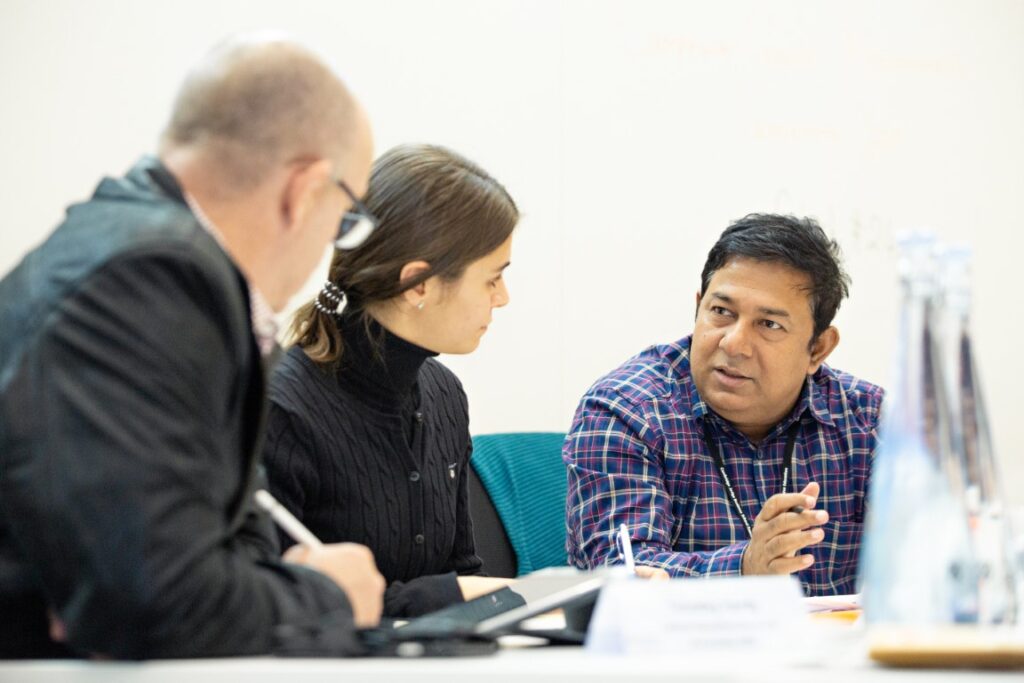
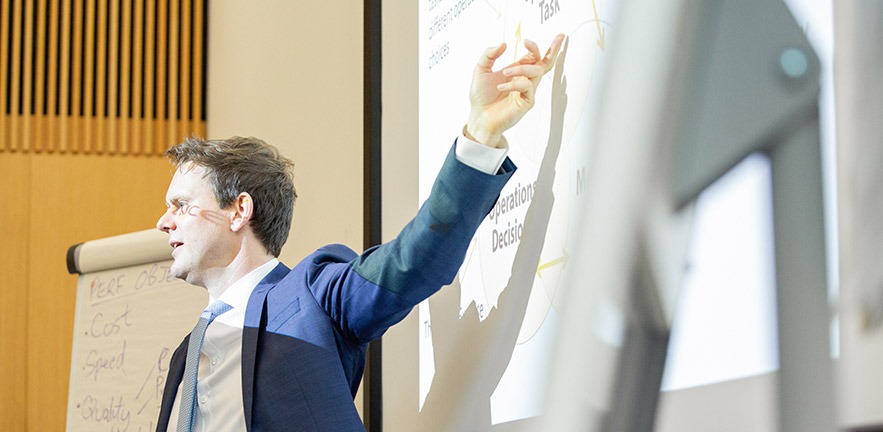
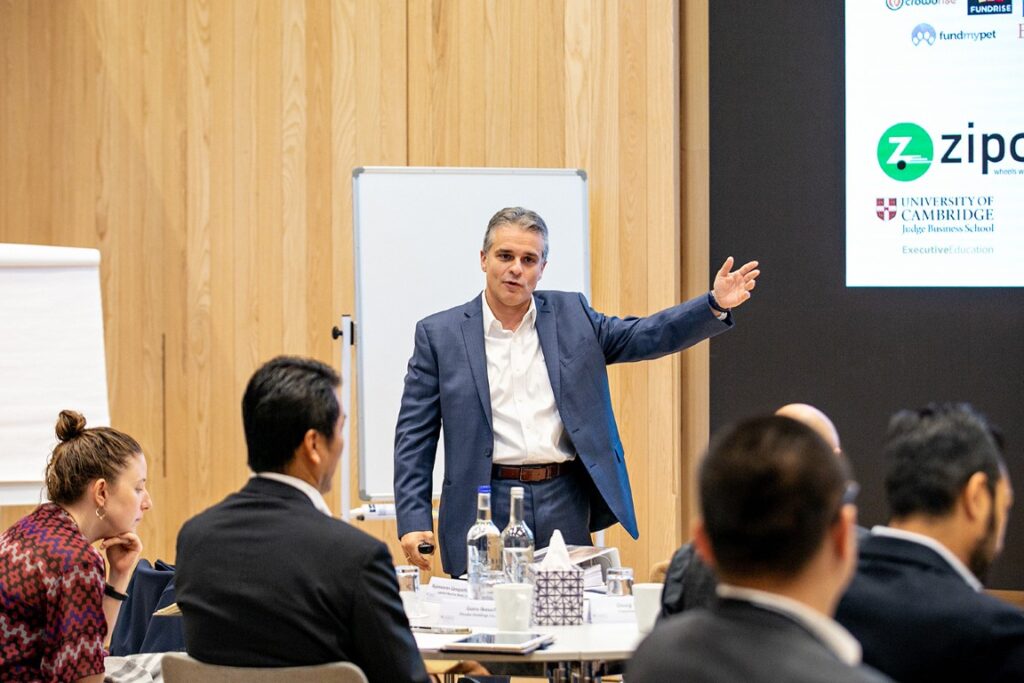
Face-to-face is a traditional, intense classroom learning experience and is all about hands-on interaction. You will be a part of exercises, debates and conversations, engaging directly with our faculty and your peers. Conversations spill over into breaktimes and meals, forming lasting connections. Share your ideas, develop your network and grow professionally.


Video

Upon successful completion of the programme, you will be awarded a digital certificate of attendance by Cambridge Judge Business School Executive Education.

Video

Why Cambridge?

All of our programmes offer the same quality and academic rigour one associates with a Cambridge University education:
Faculty
Why Cambridge?
Why Cambridge?
Why Cambridge?

Get in touch

Speak to a programme advisor

If you have any questions or would like to discuss how this programme could benefit you or your organisation, please get in touch with the programme co-ordinator.


Yangos Hadjiyannis

CEO, CIM-Cyprus Business School